PC & Acrylic Sheet Distortion Control: Thermal Expansion Calculation and Installation Clearance
The short version
When a PC (polycarbonate) or acrylic sheet mounted in a steel frame starts to bow or warp, it is not a sheet-quality problem: plastics expand about 6 times more than steel, so any temperature change makes the sheet move far more than its frame. If the bolts are tightened hard with no room to move, the stress has nowhere to go and the sheet buckles — first the appearance and door operation suffer, then cracks appear at the fixing points.
The standard practice in one sentence: design the mounting for 3 mm of expansion clearance per meter — slotted holes and bolts not locked down. The calculation, two retrofit options and the official reference are below.
1. Root cause: thermal expansion, 5–6× that of steel
| Material | Linear thermal expansion coefficient (×10⁻⁶/°C, i.e. mm/m·°C) | vs. steel |
|---|---|---|
| PC (polycarbonate) | 65 | ~6× |
| Acrylic (PMMA) | 70–75 | ~6–7× |
| Carbon steel | 11–12 | 1 |
| Glass (reference) | ~8 | — |
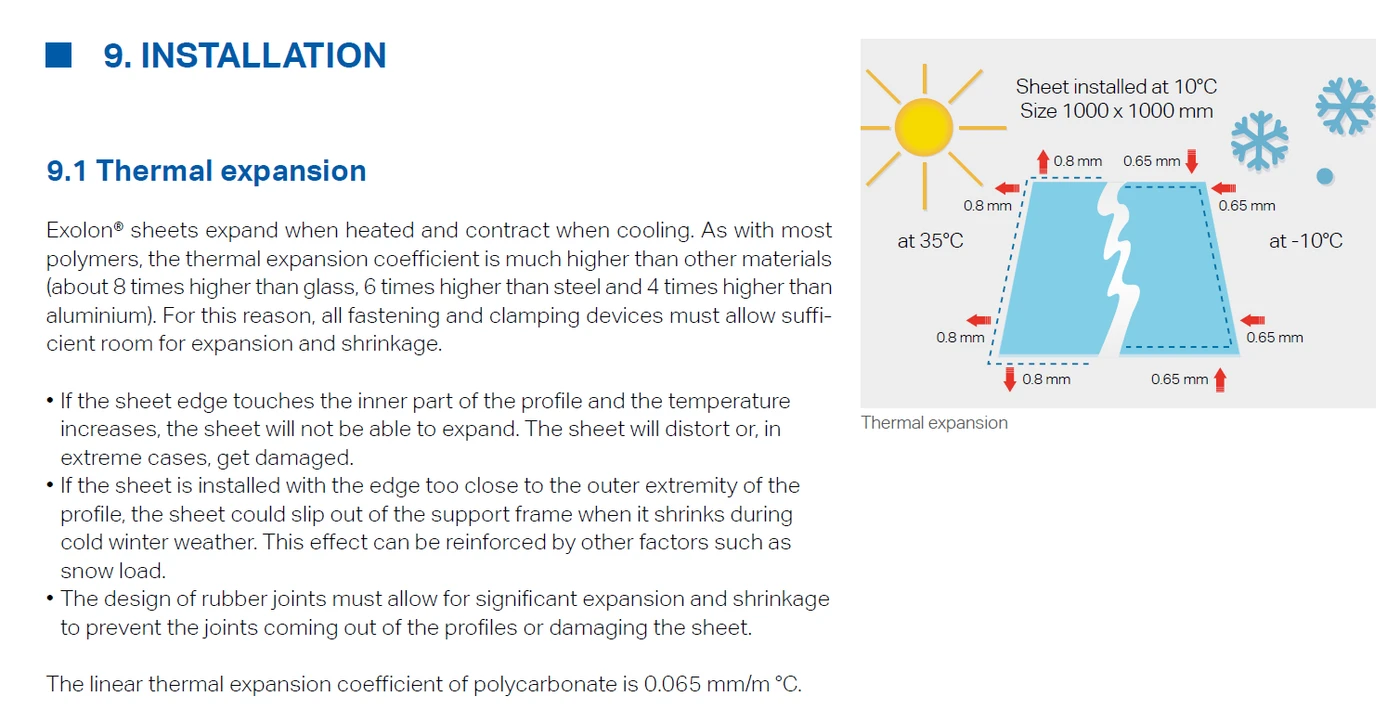
These are standard engineering values: the linear thermal expansion coefficient of PC is 0.065 mm/m·°C (65×10⁻⁶/°C) — about 8 times that of glass, 6 times that of steel and 4 times that of aluminium; acrylic is slightly higher still.
In other words, for every 1 °C of temperature change, a PC sheet moves about 53 µm per meter more than a steel frame. The longer the sheet and the wider the temperature swing, the faster this adds up.
2. A worked example: a 1800 mm door panel gains 3.34 mm
The formula: ΔL = L × α × ΔT
For an 1800 mm equipment door panel with a 35 °C difference between installation and service temperature:
- PC sheet elongation: 1800 × 65×10⁻⁶ × 35 ≈ 4.1 mm
- Steel frame elongation: 1800 × 12×10⁻⁶ × 35 ≈ 0.76 mm
- Difference ≈ 3.34 mm
If the bolts lock the sheet down, that 3.34 mm has to go somewhere:
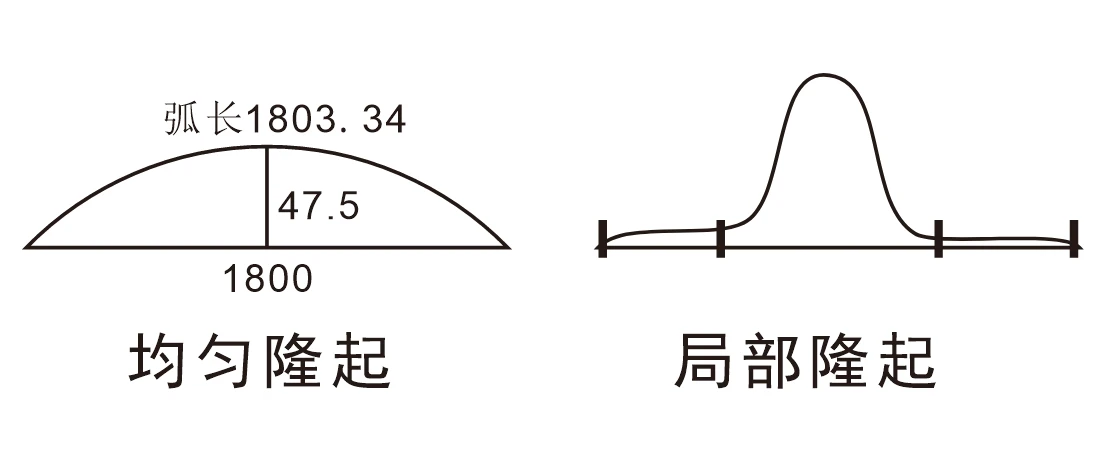
- Uniform bow: the extra length spreads into an arc — chord 1800 mm, arc 1803.34 mm, which corresponds to a bow height of about 47.5 mm;
- Local buckling: stress concentrates between fixing points, bulging even higher than 47.5 mm, with stress whitening and accelerated cracking over repeated cycles.
A common mistake is assuming the sheet “won’t move that much”. Take a 1000 × 1000 mm PC sheet installed at 10 °C: it expands 0.8 mm per edge at 35 °C and shrinks 0.65 mm per edge at −10 °C — millimeter-level movement on a one-meter square sheet. Cold shrinkage is equally dangerous: in winter the sheet can slip out of its retaining profile.
3. The standard practice: 3 mm clearance per meter
With a PC-to-steel coefficient difference of 53×10⁻⁶/°C, each meter of sheet moves 0.053 mm more than the frame per 1 °C — 3 mm per meter covers an extreme swing of about 55 °C, with rounding as a safety margin. This is the accepted rule for PC sheet installation.
Structurally, there are two levels of retrofit:
Option 1 (minimal change): fix the bolting, release the stress
Stop locking the sheet down; let the whole sheet move and distribute the stress:
- Change bolt holes to oversized or slotted (U-shaped) holes, oriented along the direction of movement, with large washers to spread the load;
- Tighten bolts moderately — never clamp the sheet dead, or the stress becomes locked in at the fixing points.
Option 2 (redesign): door-frame clamping structure
For heavy-duty or large panels, use a door-frame clamping design: clamp and locate the sheet top and bottom, and reserve the standard 3 mm-per-meter expansion clearance left and right. The top and bottom edges are held by profiles while the sheet expands and contracts horizontally — this eliminates thermally induced bowing and warping across the full annual temperature cycle.
Three more installation details are often overlooked: the sheet edge must not touch the inner wall of the profile (it cannot expand when heated and will distort or be damaged); the edge should not sit too close to the profile’s outer extremity (the sheet can slip out of the frame in winter, aggravated by snow load); gaskets and joints must accommodate the movement (so they neither come out nor pinch the sheet).
FAQ
Q: Which warps more, acrylic or PC?
By coefficient, acrylic (70–75) is slightly higher than PC (65) — both are far above steel, and the installation rules are identical: always reserve expansion clearance. They differ in mechanics and optics: PC is tougher, acrylic is harder and clearer. Material selection depends on the working conditions; the anti-distortion mounting logic is the same.
Q: Where does “3 mm per meter” come from?
With a PC-to-steel difference of 53×10⁻⁶/°C, each meter moves about 0.053 mm more per 1 °C; 3 mm covers roughly a 55 °C swing, with rounding as safety margin. For longer sheets or bigger swings, recalculate with ΔL = L × α × ΔT — it only gets larger.
Q: Doesn’t tightening the bolts make it stronger and better sealed?
The opposite. Locking the sheet down freezes thermal stress into the bolt points: at best bowing and warping, at worst cracking at the holes. “Secure” should come from a structure that locates the sheet top and bottom while leaving it free left-right — not from clamping the sheet dead.
Closing
For equipment guards, sight windows and inspection doors — any “PC/acrylic sheet + metal frame” assembly — distortion almost always comes from the mounting structure, not the sheet. Cremage designs guard and window assemblies to the practices above (expansion calculation, slotted holes and clamping structure), with sheet machining accuracy of ±0.01 mm and flatness within 0.05 mm. For an assessment of an existing structure, send us the drawings.
References
- [1] Exolon® Technical Manual Solid (Makrolon® sheet, now Exolon®), chapter 9 Installation: https://www.exolongroup.com/index.php/fuseaction/download/lrn_file/mf0261_e_210502.pdf