How Long Does PC Sheet Last Outdoors? UV Protection and Grade Selection
The short version
Whether a PC (polycarbonate) sheet survives long-term outdoor service is decided not by the base resin but by whether it carries a UV protection layer. Bare PC yellows and embrittles under ultraviolet exposure; grades with a coextruded UV layer are validated by both artificial weathering tests and natural exposure under extreme climates, and come with a 10-year weather-resistance guarantee. The selection rule in one line: outdoors, always specify a UV-protected or AR hard-coated grade; indoors, general-purpose GP is enough. No “X years of service life” figure is quoted by any manufacturer — this article covers mechanisms, warranties and selection logic, without inventing lifetime numbers.
1. What UV does to bare PC
Under ultraviolet light, polycarbonate molecular chains undergo photo-oxidative degradation — visible as yellowing, loss of light transmission, surface chalking and declining impact strength. That is also the positioning of the UV grade: it absorbs dangerous UV radiation, making it ideal for skylights and wherever UV-sensitive materials need sheltering — factory units, museums, shopping centres.
2. How the UV layer is “built into” the sheet
Three points in the UV grade’s description matter to buyers:
- Coextrusion: the UV-protective layer is coextruded with the sheet and, being polycarbonate itself, is homogeneously fused with the substrate — “no delamination of the layer is possible”, even after years of exposure to the elements or after the sheet is cold bent;
- Dual validation: the system has been tested both in artificial weathering and in natural weathering under extreme climatic conditions;
- 10-year weather-resistance guarantee: the UV-protected grade carries a 10-year guarantee on weather resistance (full terms in the manufacturer’s warranty statement).
Be precise about the wording: a guarantee is not a service life. The manufacturer promises no outdoor lifetime figure. Do not treat the 10-year warranty as an end-of-life date, and distrust any absolute “X years without yellowing” claim — go by the warranty terms and validated duty conditions.
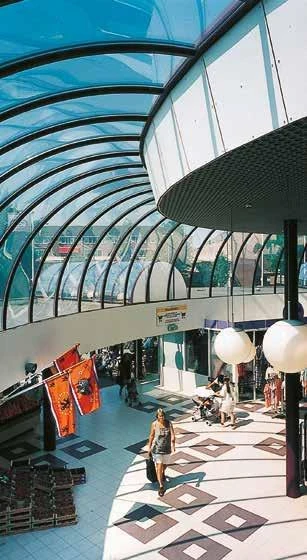
Image source: Exolon® technical manual
3. Grade quick-reference table
| Grade | Positioning | Key properties | Typical applications |
|---|---|---|---|
| GP general purpose | Standard grade | Impact resistance 250× glass; −100 to +120 °C; good fire classifications under most European standards | Indoor general use, protection, signage |
| UV protected | Coextruded UV layer | Weather-resistant, no delamination (even cold bent); 10-year weather-resistance guarantee | Skylights, canopies, outdoor cladding |
| AR hard-coated | Polysiloxane hard coat | Glass-like surface quality, high scratch resistance, graffiti removable, excellent UV resistance and superior chemical resistance; 10-year guarantee against breakage and light-transmission loss, 7-year against delamination | Noise barriers, schools/hospitals/prisons, vehicle safety glazing, machine-guard windows |
| NR non-reflective | One-side matt finish | Improved UV resistance on one side | Signage, poster glazing |
| FR flame retardant | Flame retardant | UL-94 V0, FAR 25.853, EN 45545 | Applications governed by fire regulations |
| FG food grade | Food contact | Complies with European directives and American FDA regulations | Food-equipment windows and contact surfaces |
Specialty grades also exist: DX/SX (LED diffusion and microprismatic), UV Adlight (LED backlit signs), patterned, Titan (20 mm machine guards) and SilentSound (road/rail noise barriers, noise reduction up to 37 dB).
4. How to read the grade designation
The grade designation follows a fixed system — take “UV white 2130”: type + colour + property digit + colour number + reference. “UV” is the weatherable grade, “white” the colour; in the digit string the property digit “2” means 2-sides UV-protected (“7”/“8” mean 1-side/2-sides abrasion resistant), “1” is the colour number for white, and the trailing digits are the reference number. Checking these digits before ordering prevents the classic procurement error of buying GP where UV was specified.
5. Indoor/outdoor selection logic
- Indoor only (guards, partitions, signage): GP — impact strength and temperature range are ample at the lowest cost; switch to FR where fire regulations apply;
- Outdoor glazing / canopies / cladding: UV — the coextruded layer solves yellowing, with a 10-year weather-resistance guarantee;
- Outdoor + human contact / abrasion / chemical cleaning: AR — excellent UV resistance, plus abrasion and graffiti resistance; vehicle safety glazing and machine-guard windows are among its typical uses;
- Food equipment windows: FG.
FAQ
Q: Is the UV layer still effective after the sheet is cold bent into an arch?
Yes. The coextruded layer is homogeneously fused with the sheet and cannot delaminate — even after years outdoors or after cold bending. For bend radius and process limits, see our cold bending article.
Q: Once the 10-year guarantee expires, is the sheet done?
No. A guarantee is the manufacturer’s minimum weather-resistance commitment, not a service-life limit; the manufacturer gives no lifetime figure. Actual service life varies widely with orientation, climate and cleaning — accept warranties as the governing document.
Q: Can AR hard-coated sheet be used as outdoor glazing?
Yes. AR comes with excellent UV resistance and a 10-year guarantee against breakage and light-transmission loss. But AR’s core value is surface hardness and chemical resistance — for pure daylighting, UV is the more economical choice.
Closing
The right grade is what secures outdoor service life; the wrong grade fails no matter how good the sheet. Wuxi Cremage Technology offers grade-selection consulting for PC/acrylic sheets and custom machining of sight windows and equipment guards — send us your application drawings. Further reading: PC & acrylic distortion control, PC sheet cleaning and maintenance guide.
References
- [1] Exolon® Technical Manual Solid (Makrolon® sheet, now Exolon®), Chapters 1–3: https://www.exolongroup.com/index.php/fuseaction/download/lrn_file/mf0261_e_210502.pdf